Birth Practices Around the World: The Weird, the Wonderful, and the Completely Forgotten
I’ve been thinking about birth a lot lately. (Occupational hazard, obviously!) I recently visited the amazing Welcome Collection exhibition in London. “Expecting: Birth, Belief and Protection”. One of the most interesting artefacts was a piece of animal skin from around 1500AD, three metres long and ten centimetres wide. It was inscribed with prayers, images and texts designed to protect the woman in labour. It could be wrapped around her as she laboured. This got me wondering about how woman have been supported throughout time and in different cultures.
One of the things I love most about this work is how it strips you down to something deeply human. When a woman is in labour, culture, language, postcode - none of it matters. What matters is the body doing this ancient, primal thing it was made to do.
But how we support that body? That has looked wildly different across time and across the world. And some of it will stop you in your tracks.
So let’s take a little tour. From the frankly unhinged to the quietly brilliant.
Ancient Egypt: Squatting on Sacred Bricks
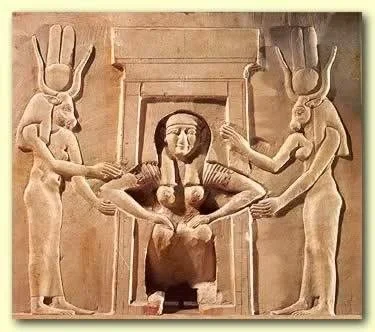
Egyptian women didn’t give birth on their backs. They squatted over two painted mud bricks - one under each foot - so the baby could emerge into the space between them. These were magical birth bricks, inscribed with the goddess Hathor and divine protection. So sacred was the practice that the Egyptian word for “birth brick” - meskhenet - was also the name of the goddess of birth herself.
The only surviving example was unearthed in 2001 at Abydos, nearly 3,700 years old. Meanwhile, the birth room was watched over by Bes - a fierce dwarf god - and Taweret, a pregnant hippopotamus goddess with a magic knife. I think there’s something rather beautiful about the idea that the scariest figures in the Egyptian pantheon were the ones assigned to protect labouring women.
Ancient Greece: Goddesses, Midwives, and the Birth Chair
The Greeks had Eileithyia - goddess of labour - who was genuinely believed to be able to speed up or slow down your birth on a whim. Prayers were not optional. Upright birth positions were standard: chairs, kneeling, standing, because ancient women understood without clinical trials that gravity works.
It would take until the 17th century for lying-down birth to take over Western medicine - largely because male physicians found it easier to manage a woman on her back. Until then, women across the world had been labouring upright for millennia.
Ancient Mesopotamia: Amulets Against Lamashtu
The greatest fear in Mesopotamian birth wasn’t haemorrhage - it was Lamashtu, a demon who killed or stole newborns. Labouring women wore amulets invoking the protective demon Pazuzu - who, despite being a demon himself, was Lamashtu’s enemy and therefore the mother’s protector.
There’s something I find deeply moving about this. Every culture - every single one - has built rituals around birth because birth is that powerful. The instinct to protect and surround a labouring woman is ancient and universal.
Medieval England: Witches, Oaths, and Tapestried Rooms
Birth was strictly women-only. Noble women would “take their chamber” weeks before the birth - windows covered with tapestries, room sealed, men excluded entirely. Labour pain was understood as a consequence of Eve’s sin, not a medical event, which meant pain relief wasn’t really the point.
Midwives held enormous expertise and power - so much so that the Church required them to be licensed by a bishop and swear an oath that they would not use magic. Which tells you something important: an institution as mighty as the Catholic Church felt it needed to regulate them.
The Twilight Sleep Era: The Most Disturbing Chapter in Obstetric History
If you think modern birth culture has its problems - let me introduce you to Twilight Sleep.
From 1914, a combination of morphine and scopolamine became fashionable: morphine for pain, scopolamine to cause amnesia. The catch? Scopolamine didn’t stop pain. It just stopped women forming memories of it. So women were still in agony - screaming, thrashing - but wouldn’t remember why. Because of the thrashing, they were physically restrained. Photographs show women tied to beds, sheets soiled, surrounded by clinical indifference. This was considered progress.
The assumption that a woman’s experience doesn’t matter as long as the baby arrives safely runs through obstetric history like a dark thread. We are still, in some places, untangling it.
The Rebozo: Mexico’s Ancient Tool That Doulas Are Bringing Back
The rebozo is a hand-woven Mexican shawl used by parteras (traditional midwives) for centuries, likely dating back to pre-Columbian Mesoamerica and it’s now in birth rooms worldwide, including mine.
During labour it can be wrapped around the belly for support, or used to “sift” the pelvis - a gentle rocking motion that relaxes the pelvic ligaments and encourages optimal baby positioning. Research backs what Mexican midwives have always known: it measurably reduces labour pain. There’s something quietly radical about a piece of woven cotton outperforming pharmaceutical interventions. Traditional knowledge doesn’t become obsolete, sometimes it just waits to be rediscovered.
The Inuit: Whispered Directions and a Calm, Sacred Space
Traditional Inuit midwives would whisper their directions to labouring women. Not quiet voices - whispers. Birth was a calm, peaceful affair, supported with extraordinary gentleness.
I think about this often. Modern birth science knows that fear and perceived threat activate the stress response, which can slow or stall labour. Safety, calm, and trust do the opposite. The Inuit midwives didn’t have the research - but they had the wisdom. When I am supporting a mum in labour I try to keep the whole process calm, dimly lit, quiet, stress free and if there’s a transfer to hospital I keep the process as streamlined as possible. I do everything in my power to keep the oxytocin flowing.
West Africa: Silence as Protection
In parts of West Africa, labouring women were encouraged to stay as quiet as possible - noise was believed to attract evil spirits. You might smile at the superstition. But there’s a parallel to modern hypnobirthing and other approaches that use quiet, inward focus to support the physiology of labour. The instinct to protect the labouring woman’s environment from chaos is remarkably consistent across cultures, whatever the rationale.
Nigeria: The Nana Fatsuma Ritual
In some Nigerian Muslim communities, when labour becomes severe or difficult, a stick named after Nana Fatsuma, a wife of the Prophet Muhammad - is dissolved in water and given to the labouring woman to drink, to hasten delivery and protect the baby.
Whether the mechanism is faith, placebo, or something in the plant material itself, it brings comfort and a sense of protection at one of the most vulnerable moments of a woman’s life. That matters.
Nepal: Shamans, Goddesses, and the Aji
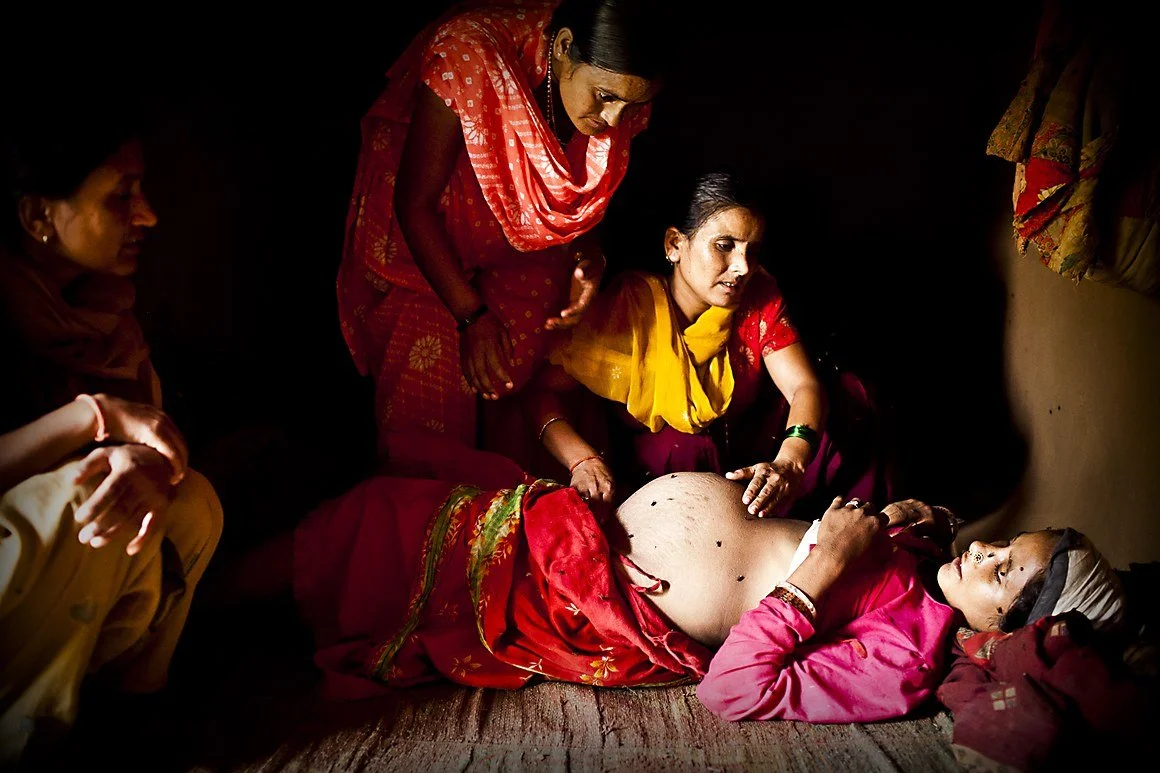
so we come to Nepal, dear to my heart and where I developed a love and respect for women and their ability to birth their babies. Nepal layers Hindu, Buddhist, and indigenous traditions across dozens of distinct ethnic groups, and birth practices reflect that richness completely.
Among the Newar people of the Kathmandu Valley, the aji is both midwife and priestess - responsible not just for the birth itself but for invoking the protection of Chwaasa Ajima, the goddess of childbirth, and performing the baby’s first life-cycle ritual shortly after birth. In rural Nepal, a prolonged labour might call in a dhami-jhankri (shaman), who understood difficult birth not as physiological malfunction but as a spirit disturbing the body’s balance and whose job was to appease or expel it through chanting, drumming, and sacrifice.
For stalled labour, women also used herbal soups, abdominal massage, and oil. For retained placenta, bitter herbal water and if necessary, induced vomiting, on the fairly logical theory that the physical force might help. Not glamorous. Pragmatic.
Then there’s the harder part. Across many Nepali Hindu communities, childbirth was considered a state of ritual impurity, and in parts of western Nepal, the practice of chhaupadi could mean a woman gave birth in a cattle shed, alone. It was embedded in a religious logic about purity, but the human cost was real - and has been the subject of serious campaigning and legal reform.
What I find remarkable about Nepal is the sheer variety: the aji performing sacred rituals, the shaman outside, the herbal soups, the Brahmin priest brewing ceremonial tea. And running through all of it, the same question that runs through birth culture everywhere - whether the woman at the centre is being held in protection or pushed to the margins. I will advocate for my mums, they are not a number in the NHS but a unique combination of mum and baby that needs a specific tailored support.
Ancient “Medicine”: The Truly Alarming Entries
I feel I should, in the spirit of honesty, mention some practices that are harder to frame charitably.
In ancient Greco-Roman medicine, a drink sprinkled with powdered sow’s dung was given to relieve labour pain. Fumigation with hyena fat was thought to produce immediate delivery. The Hippocratic texts noted a possible placebo effect, which feels like a generous reading of the situation.
Ancient practitioners were doing their best with what they had. But I think we’re allowed to be glad that chapter has closed.
The Thread That Runs Through All of It
Here’s what strikes me most, having looked at birth practices across thousands of years and dozens of cultures.
Every single one - however strange, however rooted in a belief system we don’t share, involves women gathering around other women. Rituals to create safety. Attempts to manage pain and fear. Protective figures, real or divine, positioned at the threshold.
The Inuit midwife whispering. The Egyptian goddess painted on a brick. The Mexican partera with her rebozo. The Nigerian woman and the Nana Fatsuma ritual. The Newar aji invoking Chwaasa Ajima. The medieval neighbours gathered in that tapestried room.
All of them understood something we are still trying to reclaim in modern Western birth: that a woman in labour needs to feel held, protected, and accompanied. That the people around her shape her experience profoundly. That birth is not just a medical event but a human one.
That’s why us doulas exist. And why, for as long as humans have been having babies, we’ve always found our way back to each other. I’m here to support you too. Just book in a chat and we can get started.